
What the numbers inside the temple arm mean
Turn the glasses over or find a photo of the inner side of the arm. That is where the model code and color code usually live, next to the size. A look-alike frame can fool you. A matching code with matching measurements is the strongest confirmation you can get.
Size marks use millimeters and normally hold three numbers in a fixed order: lens width, bridge width, temple length. EyeBuyDirect's measurement guide reads 52-18-140 as a 52 mm lens, an 18 mm bridge and 140 mm temples. Across EyeBuyDirect, Warby Parker and All About Vision, lens width typically runs 40 to 60 mm and bridge width 14 to 24 mm. Temples run 120 to 150 mm.
Some makers add a fourth number for lens height. Warby Parker gives a typical range of 32 to 38 mm. EyeBuyDirect also sorts lens width into small at 50 mm or less, medium at 51 to 54 mm and large above 55 mm, which helps you judge a frame you only see in a picture.
Read the string left to right. Reading it backward turns a 140 into a lens width and sends you to the wrong frame. Lens width is also not the width of the whole frame, so do not compare the two.
Eyeglass and sunglass frame shapes you will run into
Name the outline before anything else. It cuts a catalog of thousands down to a short list. The table covers the shapes you will meet on both men and women, since most lines sell the same silhouettes to everyone.
| Shape | What to look for |
|---|---|
| Round | Lens about as tall as it is wide. A true circle is rarer than it looks. |
| Oval | Wider than tall, with no corners. Perspective makes it hard to tell from round, so use the height-to-width ratio. |
| Rectangular and square | Straight top and bottom edges. Square lenses are close to equal in height and width. |
| Geometric | Hexagon, octagon or other cut-corner lens. |
| Cat-eye | Outer corner rises, sometimes with a pointed brow extension. |
| Aviator | Large teardrop lens, thin rim, usually a double bridge and nose pads. |
| Wayfarer | Thick acetate rim, angled brow, wider at the top than the bottom. |
| Browline | Visibly heavy upper rim, light or missing lower rim. |
| Shield | One broad lens, or two lenses that blend into a single visor. |
| Wraparound | Curved lens that follows the face toward the temples. |
Perspective is the trap. A frame photographed from slightly below looks rounder and shorter than it is, and a camera held close stretches the front. Judge the shape from a straight-on view when you can get one.
Rims, bridges and hinges that point to one model
Shape gets you a family. Construction gets you the model.
Start with the rim. Full-rim frames wrap the whole lens. Semi-rimless frames leave one edge bare, and rimless frames mount the lens with screws. Wire frames use a thin metal rim.
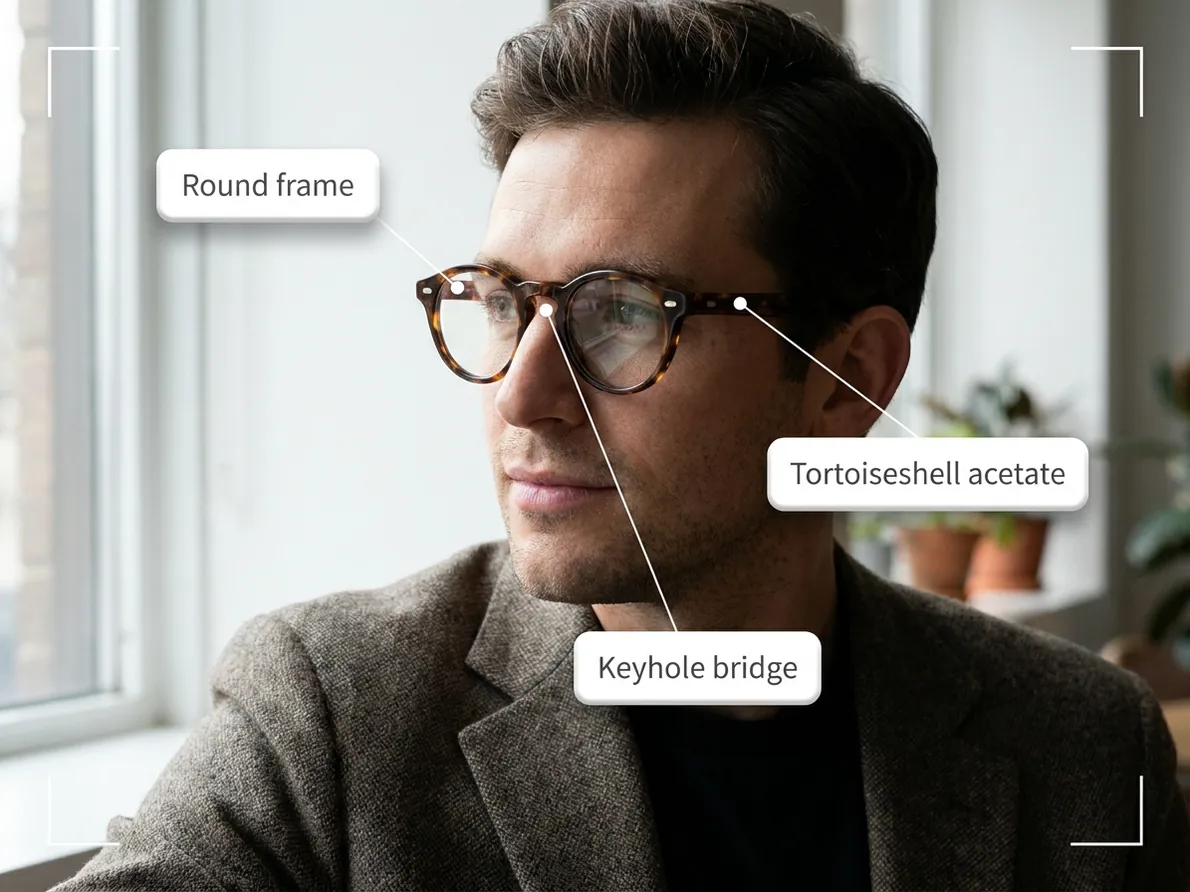
Then check the bridge. It can be straight, arched, keyhole or saddle, rest on nose pads, or come as a double bridge. A keyhole bridge is a small round notch, and spotting one quickly separates two frames that otherwise match.
Look at the end pieces and hinges next. Some are plain, some are sculpted, and some carry rivets, a hinge logo or other hardware that only one line uses. Finish with the temple arm itself. Note its thickness, whether it tapers, any color contrast, a metal core, engraving, where the logo sits and the shape of the tip.
Write these down as a list. Five matching details beat one strong impression.
Frames that look alike and how to separate them
- Wayfarer or plain rectangular acetate. Compare the brow angle, the end-piece shape, the bridge and the temple logo. A true wayfarer has the sharper brow.
- Cat-eye or upswept square. Check whether the outer corner rises sharply and whether the brow has a pointed extension.
- Aviator or pilot frame. Compare lens shape, how many bridges there are, the brow bar, rim thickness and nose pads.
- Browline or thick acetate. A browline has a visibly heavier upper rim and a lighter lower one.
- Clubmaster-style or browline. Look at the keyhole bridge, the lower rim, how the temple is built and exactly where the logo sits.
- Older or newer release of one model. Compare hinge hardware, logo font, bridge shape, lens size and the suffix on the model code.
Metal and plastic fool people too. Reflections and color can mislead, so look at the hinge, the cut edge of the rim and the inside of the temple instead.
Acetate, metal and tortoiseshell: reading the material
Common frame materials are acetate, injected plastic, stainless steel and titanium. Finish adds another layer. A frame can be translucent, tortoiseshell, matte, gloss or two-tone, and a tortoiseshell pattern on one model often appears on a dozen others.
From a photo you can say what a frame appears to be made of. You cannot say it is titanium or acetate with confidence. Claiming a material, a manufacture year or a safety rating with no evidence is a mistake worth skipping. If the material matters to you, ask the seller for it in writing.
What sunglasses are these: tint does not name the model
When you ask what sunglasses are these, remember that an optical frame with tinted lenses can be built exactly like a sunglass frame. The tint tells you nothing about the model. Lenses can be clear, tinted, mirrored, gradient, polarized, prescription or photochromic, and those are separate choices from the frame.
The lens look also fails as proof of protection. Lens appearance alone does not show polarization or UV protection, and a frame identified correctly does not prove that prescription lenses, UV protection or polarization are in it. For anything safety related, ask an optician or an authorized seller.
Photographing glasses so they can be identified
- Start with the highest resolution original you have, then crop the glasses tightly without enlarging past the point where they blur.
- Take a front shot that shows both lenses, the bridge, the rims, the nose pads, the hinges and the end pieces.
- Take a side shot of the temple arm and anything printed on it.
- Photograph the inside of both temple arms in strong, indirect light so the print does not glare.
- Write down every letter, number, symbol and size mark you can read, including country of manufacture and any small compliance marks.
With only a candid street shot of someone you do not know, or a screenshot, rely on the view of the front and the shape of the temples. Send it through the scanner on this page for a description of the shape, rim and lens, which gives you words to search with. Take the answer as a suggestion only.
Searching once you have a code or a clear description
If a brand is visible, search the exact code together with the brand name. If not, search by construction instead of color. "Black sunglasses" returns millions of frames. "Round tortoiseshell acetate keyhole bridge" does not.
Reverse-image search finds visually similar frames and indexed retailer listings, but it often returns look-alikes rather than the exact model. Brand catalogs and retailer archives are better, because they let you match model codes, color codes and dimensions, even for discontinued pairs. An optician can read marks and measure the frame, and a manufacturer's customer service may confirm a model from a readable code and photos, though replies vary. For a brand you cannot place, the brand identification page covers the logo side of the job.
Secondhand marketplaces are the best place for discontinued frames, but sellers get brands and models wrong. Do not trust a single listing. Compare the seller's measurements with the numbers on the frame, then compare their photos with the maker's or an authorized retailer's. When two independent listings agree with the code, you can call the result confirmed. If only the look matches, call it probable. If you only have a resemblance, call it unknown.
When the original is discontinued or out of budget, a cheaper look-alike frame search can fill the gap, as long as you buy the look-alike for what it is.
Wrong-frame traps to avoid
- Skipping the inside-temple code.
- Treating a logo as proof of the exact model.
- Trusting a front photo that hides the temples and hinges.
- Mistaking a current model for a discontinued one.
- Confusing a frame's retail price with what a pair sells for secondhand.
- Treating a reverse-image or AI result as confirmation.
Safety and privacy with frame photos
Crop out children, documents, addresses and license plates. Strip location data from the image where you can. Read a search service's terms first, because storage, retention, human review and model-training policies differ.
A frame that looks right online may not be authentic. Counterfeit eyewear can make false claims about UV protection, impact resistance, prescription accuracy or materials, so buy safety-critical pairs from an optician or an authorized seller. And do not try to pin down a private person from their glasses. Many brands and models share the same look.
The same habits help with other accessories, including naming a hat from a photo. The same method of clear shots, written details, then a search also drives identifying a necklace and finding outfits from a photo.
Frame questions, answered
Where is the model number on a pair of glasses?
On most frames it is printed or engraved on the inside of one temple arm, the long piece that runs back to your ear. The brand, model code, color code and size often sit together there. If the arm is blank, check the inside of the other arm, the bridge and the nose pads, and photograph each one in bright indirect light so the print is readable.
What do numbers like 52-18-140 on glasses mean?
They are measurements in millimeters, written as lens width, bridge width and temple length. A 52-18-140 frame has a 52 mm lens, an 18 mm bridge between the lenses and 140 mm temple arms. Keep the order straight, because reading it backward sends you to the wrong size. These three numbers narrow down a model only when you pair them with the model code.
How do I identify sunglasses from a picture?
Describe the outline, rim type, bridge and hinge, then look for a brand or code on the temple. Search by those construction details instead of the color. Remember that lens tint does not name a model, because an optical frame with tinted lenses can be built the same way as sunglasses. Compare candidates on at least five details before you decide.
Can I tell if glasses are polarized or have UV protection from a photo?
No. Lens appearance alone does not reliably show polarization or UV protection, and identifying a frame correctly does not prove those features are present. Dark lenses are not proof of UV blocking either. If protection matters, check the product listing or ask an optician, who can test the lenses and read the markings on them.
What if there is no brand or code on the frames?
Work from the details you can see: the shape, rim type, bridge, end pieces, hinge hardware and temple design. Write them as a short description and search that. Measurements help a lot, so measure the frame with a ruler if you can hold it. Without a code, the honest result is probable at best, and an optician may place it faster than a search.
Is a reverse image search enough to find the exact frames?
Usually it gets you close, not exact. Reverse-image search finds visually similar frames and retailer listings, and it often returns look-alikes. Use it to find candidate names, then confirm with a model code, matching measurements and photos from the maker or an authorized retailer. Treat any single result, whether from a search or an AI tool, as a lead.
Are glasses on a resale site real if they look right?
Not necessarily. Counterfeit pairs can copy a frame closely, and listings on secondhand marketplaces can carry the wrong brand or model. Check that the seller's measurements match the frame markings, compare the logo and hinge with an authorized retailer's photos, and avoid relying on one listing. For prescription or sun protection claims, go through an optician.