
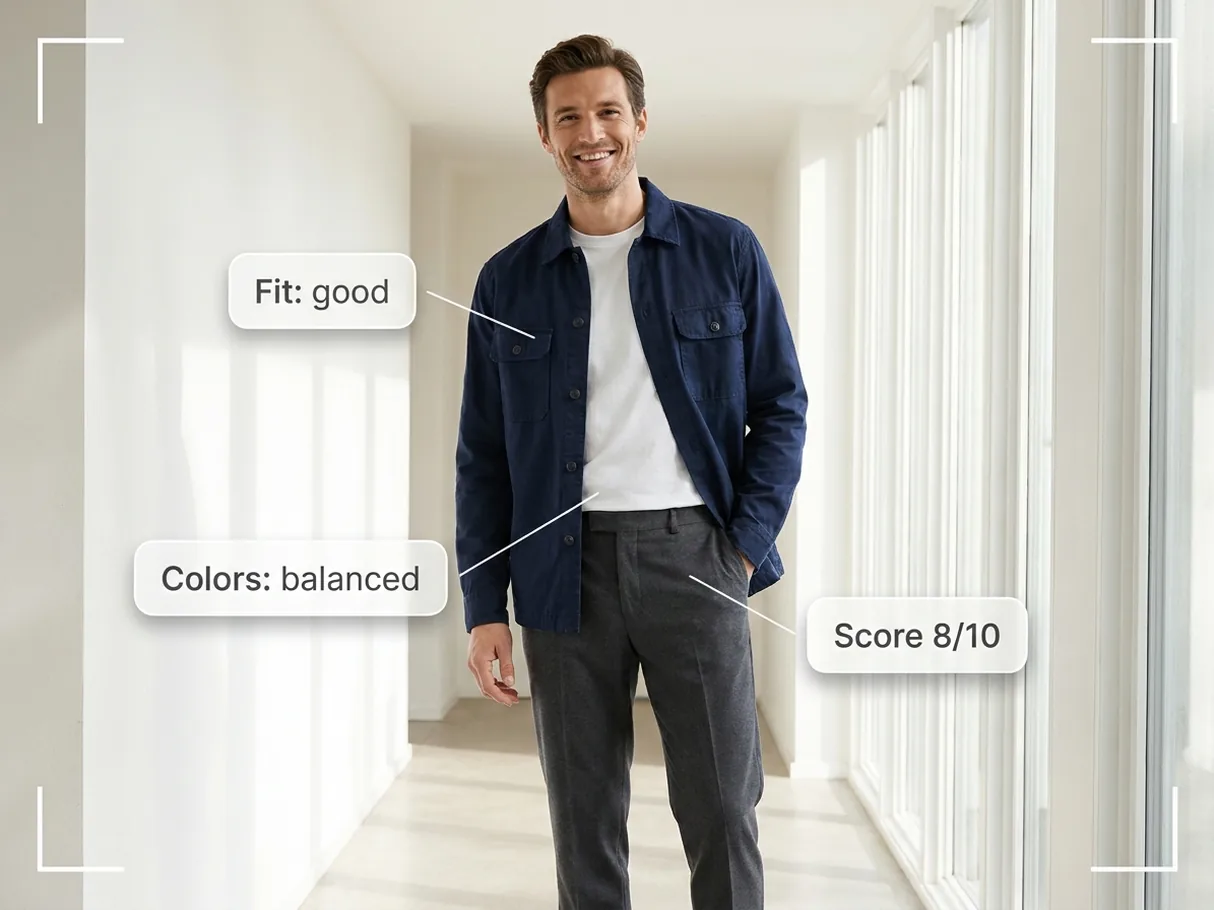
What an outfit checker actually looks at
Apps that rate a look tend to score a handful of things. Outafit, for example, lists color coordination, fit, style coherence, how well the outfit suits the occasion and current trends. Other wardrobe tools describe similar checks. The result is an algorithm's opinion, not a standard fashion certificate, so treat a number as a prompt to look again, not as a verdict. If the look is not working, an outfit generator for new combinations can offer alternatives.
Here is what each factor means when you look at your own reflection.
- Color. Do the shades sit well together, and is there one clear lead color or are three loud ones competing?
- Fit. Do the shoulders, sleeves and hems land where the garment was cut to land?
- Coherence. Do the pieces belong to the same level of dressiness, or does a sharp blazer sit on top of gym shorts?
- Occasion. Would you feel right in this at the place you are going?
If you upload a photo to the scanner above, it can describe the outfit, rate it out of 10 and suggest fixes. It reads what is visible in the picture, so a crisp, well-lit photo gets more useful comments than a dim one.
How to photograph an outfit so the feedback is fair
A bad photo creates bad feedback. Dim light turns navy into black and makes blended colors look muddy. A wide-angle phone lens at close range stretches whatever is nearest to it. Fix these first and the rest improves.
- Stand near a window in daylight, with the light in front of you, not behind.
- Hold the phone at chest height, a few steps back, and keep it level so lines stay straight.
- Include your shoes. Half an outfit is hard to judge.
- Take a front shot and a side shot. A jacket that looks fine from the front can pull or bunch in profile.
- Take the photo standing normally, with your arms relaxed, not posed with a hand on the hip.
- Use a clean background and crop out faces of other people.
A mirror selfie works if the mirror is clean and full length. Wipe the glass, step back so your whole outfit is in the frame and turn off the flash, which flattens fabric and washes out color.
Checking fit on a menswear outfit
For men, the same four spots tell you most of the story. Shoulder seams should sit where your shoulder ends. If they droop toward the arm, the jacket or shirt is too big, and if they climb toward your neck, it is too small. Sleeves on a jacket should end near the wrist bone, with a sliver of shirt cuff showing. Trousers should break lightly on the shoe, not pool in folds around the ankle. A tee should end around the middle of the zipper on your jeans, not at the knees or the belt line.
Check the collar too. A shirt collar should lie flat around your neck, and a tie knot should sit snug against it. When an outfit feels off but you cannot say why, one of these four spots is usually the answer.
Checking fit on a womenswear outfit
For women, start the same way and add a few things. A blazer or coat should close without pulling at the button, with sleeves that end at the wrist. Trousers should hang straight from the hip without crawling or wrinkling at the crotch. Skirt and dress hems should end at the same point each time you wear them. A midi that cuts mid-calf can look chopped with the wrong shoe, so try a boot, a pointed flat or a heel to see what lengthens it.
Watch how tops sit at the underarm and across the back. Gaping, pulling or sliding straps tell you the cut is wrong for you, not that you are wrong for the cut. Sizes are not standardized across brands, so a number on a tag does not decide anything. Fit is what the garment does on you today.
Color and pattern problems an outfit checker can spot
Color is where feedback is easiest to give and easiest to take. Look at three things.
First, contrast between your top and bottom. High contrast, such as a white shirt on dark trousers, makes a bold break at the waistline. Low contrast, such as camel on tan, makes a calmer line. Neither is wrong, but you should choose on purpose.
Second, undertone. Cool grays and blue-based reds sit well together. Warm browns and olive work as a team. Mixing a cool gray with a warm brown can look like a mistake, even though each piece is lovely alone.
Third, pattern. Mixing stripes and checks works when the scale differs, such as wide stripes with a small check, and when one color repeats between them. Two patterns at the same size usually fight.
Cameras also change color. Lighting and image processing can shift a shade, so a dark brown can read as black. If a checker says a color is off, glance at the real thing in daylight before you change anything.
Proportion and balance
Proportion is about how the pieces divide your outfit visually. A cropped jacket over high-waisted trousers shows a short top block and a long bottom block. A longline coat over slim trousers does the reverse. Choose one half to carry volume and keep the other cleaner.
- Oversized top, slimmer or straight bottom.
- Fitted top, wide or flared bottom.
- Long coat, shorter layers underneath that show at the hem.
- Cropped jacket, higher-waisted bottom so the lines connect.
If everything in the look is loose, add one structured piece, such as a belt, a firm bag or a tailored jacket. If everything is fitted, loosen one layer. A quick test is to squint at your reflection. If you see a clear shape rather than a blur of equal blocks, the proportions are working.
Reading the score without being misled
A rating out of 10 is shorthand. It reflects what the tool measured, which might be color match and style coherence, not your plans for the evening. A 6 for a work outfit might mean a clash of formality. A 9 might mean the pieces match, not that the fit is right.
Read the comments, not the number. Pick the one or two suggestions you agree with and change those. Do not rebuild a look you like because a number came back low. And if you ask the same tool for feedback on the same outfit in three photos and the number swings a lot, the photo is the variable.
Scores say nothing about you. They are not a statement about your appearance, body or taste. They describe clothes in a picture.
When to get a human opinion instead
Software is poor at nuance. It does not know the dress code of your office, the culture of your event or that your friend's wedding is in a barn. For high-stakes moments, such as an interview, a wedding or a first meeting with in-laws, ask a friend who dresses well, a tailor or a salesperson who works in a shop you trust. Ask a specific question, such as "does the jacket pull across the back?" rather than "how do I look?" You will get a useful answer. For a comparison of what each side does well, read about how an AI stylist differs from a human one.
If your question is what to put on in the first place, rather than how a finished look reads, start with deciding what to wear for the day.
Privacy and full-length photos
An outfit photo can show your face, your home and your neighborhood, so trim the frame down to you and the clothes. Services handle photos differently. StylePal says uploaded photos are kept until you delete them or your account. Outafit says images are processed in real time and deleted right after the rating. Nouva says its labeling runs on the device.
Terms and retention periods change, so read the policy of whichever service you use on the day you upload. Do not upload another person's photo without their permission.
Finding the pieces you want to swap
Sometimes the feedback is simply that one item is wrong. A better shirt, a different pair of shoes, a bag in another color. Once you know what to replace, photograph the item you like on someone else and learn what it is. Try finding a shirt from a photo or look at what shoes are in a picture. When you only have a screenshot of a whole outfit, finding outfits from a photo starts with isolating one piece at a time.
Does it really work? Quick answers
How accurate are AI outfit raters?
They are consistent about color matching and obvious clashes, and weaker on taste, context and fit details that depend on how the photo was taken. A score reflects the factors the tool measures, such as color coordination or style coherence. It is not a standardized fashion judgment. Use it as a second pair of eyes and keep the final decision for yourself.
What makes a good outfit photo for rating?
Use daylight from a window in front of you, hold the phone level at chest height and stand back far enough to show your shoes. Take a front and a side shot. Keep the background plain and avoid flash. A clear photo lets the tool judge the clothes rather than guess at them through blur.
Can a checker tell me if an outfit suits the occasion?
Only in general terms. It can say a look reads as casual or dressy, but it does not know your office culture, venue or weather unless you describe them. Tell it where you are going if the tool allows. For a wedding, interview or formal event, ask a person who knows the setting as well.
Does a full-body photo put me at risk when I upload it?
Services handle this differently. Policies differ on how long photos are kept and whether they go to outside vendors. One service says photos stay until you delete them, another says images are deleted right after rating. Crop out faces of others and your surroundings, and read the privacy policy before uploading.
What should I fix first if an outfit feels off?
Check fit, then color, then proportion. Shoulders, sleeve ends and hems solve most problems. Next, look for a clash between colors or patterns. Last, balance volume, so a loose top meets a slimmer bottom or the reverse. Change one thing at a time and look again before changing a second.
Do I need a different checker for menswear?
No. The principles of fit, color and proportion work for any outfit. The details differ. For men, check shoulder seams, sleeve length against the wrist and trouser break. For women, check closure at the button, hem length and how the top sits at the underarm. A good tool describes what it sees in either case.
How do I rate my outfit if I am alone?
Take a front and side photo in daylight, then look at them a few minutes later. You will notice things you missed in the mirror, such as a hem that curls or a collar that sits crooked. Compare two options side by side, and ask whether you would wear it again tomorrow.