
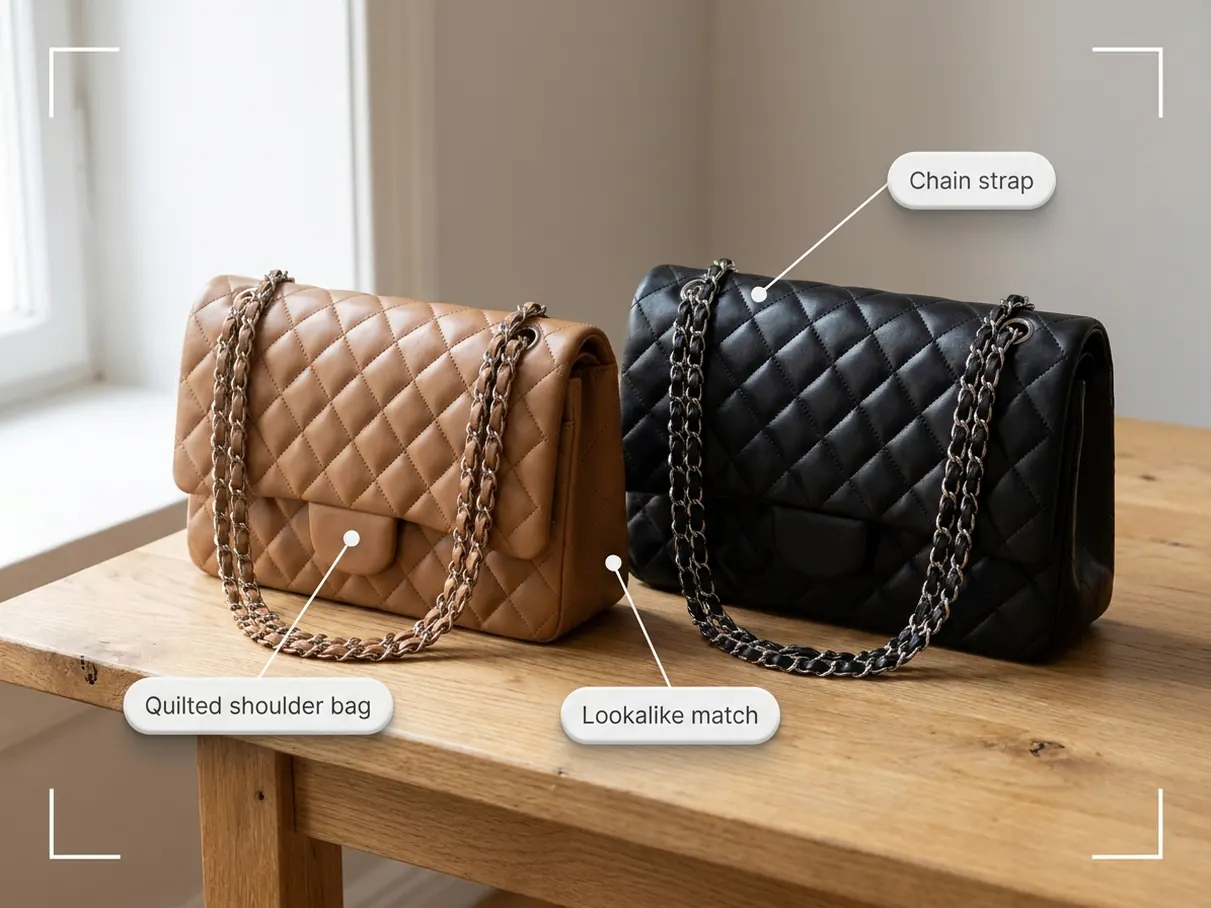
Where a clothes dupe ends and a fake begins
People use the word loosely, so settle it before you shop. A fashion dupe is a garment, shoe or bag that borrows a shape, a color or a detail from something pricier and carries its own label or none at all. A counterfeit carries someone else's logo, monogram or name to pass as the real thing.
The law treats them differently. Brand names, logos and protected designs can cause legal trouble, and the rules vary by country. A generic, unbranded lookalike is legally different from a counterfeit with another brand's logo on it. We would add a plain shopper's rule. If the listing leans on a famous logo to sell, or the seller calls it a dupe while the tag shows the original brand's name, walk away. Using the word dupe does not turn a fake into something else.
Six moves that turn a photo into a short list of lookalikes
- Start with the sharpest version of the photo you can get. Blurry screenshots return blurry results.
- Crop to the one item you want. Remove the person, the background and every other garment.
- Run that crop through Google Lens and look at both the exact matches and the similar ones.
- Search again with words, such as "black quilted shoulder bag gold chain," because color and material in text sharpen what the image search guesses.
- Repeat with separate crops of the hardware, the sole, the label, the neckline or the pattern. A buckle often finds a product that the full photo misses.
- Write down each candidate with its brand, model name, color, dimensions, material, price, shop and the date you checked.
Short on words for the piece? Let the scanner above describe it first. It writes a short description with a confidence level, and that gives you words for the text search. If the original itself is the mystery, our guide to identifying a brand from a label or logo comes first.
What each search tool does well
Google Lens. It works on photos and screenshots and can show exact or similar products, with prices, deals, reviews and sellers when they are available. Google said in a 2021 publication that people had used Lens more than 1 billion times to identify items and get styling suggestions. Fashion accessories, including bags, watches, wallets, rings, bracelets and sunglasses, are the shopping category Google cites as most searched.
Lens multisearch. This lets you pair the image with a few words, which is how you ask for the same shape in another color or a different material.
Circle to Search. On supported phones, you draw around part of an image or video and look for that item and similar ones. It is handy when the outfit sits in a video you cannot pause cleanly.
Dedicated dupe apps. Dupe.com, FetchFashion and Copped appear in 2026 commercial guides as AI tools that match a photo to cheaper products. StyleSteal says you can upload a photo or screenshot to search for clothing, shoes, bags and accessories. Treat them as extra sources of ideas. Independent accuracy figures for these apps do not exist yet, so do not assume the first answer is the right one.
Be skeptical of the sales pitch, too. A 2026 guide from Spree says some AI dupe tools claim matches that are 50% to 90% cheaper than the original, and that figure is marketing, not an independently verified average. A separate 2026 review from Fashion AI Daily warns that affiliate commissions can shape which products an app shows you. A ranking that earns money from clicks is not a neutral recommendation.
For bags in particular, our bag identification guide shows which details to isolate first.
How to label what you found
A visual match is not proof of brand, authenticity, material or current stock. Google says Lens matches patterns such as ruffle sleeves or vintage denim, which is a long way from confirming a model. Give each result an honest label before you act on it.
| Label | What has to be true |
|---|---|
| Exact identification | Model number, label, dimensions and construction all agree with the original. |
| Probable match | Most details agree, but one or two, such as the lining or the strap drop, are missing or unclear. |
| Similar style | The overall look agrees. Construction and materials may be very different. |
| Inspired lookalike | A different maker's product built to evoke the original. This is the dupe you can buy in good conscience. |
Quality checks for a fashion dupe
Cheap is only a deal when the thing lasts. Photos can fool you, so read the listing like a detective.
Fabric content and the care label
A picture cannot prove whether something is leather or synthetic, cotton or polyester blend. Read the product description and the care label details for the material percentages. If a listing says leather, vegan, sustainable or ethical without a verifiable source, treat the claim as unproven. A fabric you cannot identify is a reason to ask the seller or skip it.
Construction details
Two garments with the same silhouette can be built nothing alike. Compare the seams, pockets, lining, closures and fabric texture. On a coat, a cropped jacket, an overshirt and a shacket can look almost the same, so check length, collar, lining and fastening. On leggings and slim trousers, look at the waistband, the fly, the belt loops and whether the fabric is opaque.
Bags and shoes
For bags, compare quilting, hardware, strap width, handle drop, stated dimensions and structure. For shoes, compare toe shape, heel height, sole thickness and the buckle or closure. A strap that is a little thinner and a chain that is a little lighter change how a bag wears all day, even if the photo looks identical. If you shop shoe lookalikes, this shoe identification guide lists the details worth matching.
Work out the real price of a lookalike
The sticker price is rarely the whole story. Add shipping, taxes, return costs and, for secondhand pieces, any authentication fee. Then check your payment method and the return policy, and walk away from any seller who asks for irreversible payment. A big discount stops being a deal when the return is a lost cause.
Dates matter too. Prices, stock and search results move, so note when you checked each listing. A product that still appears in a search may have sold out months ago.
Finding a dupe for a whole outfit or a single dress
If the photo shows a full look, break it into pieces and run each one on its own. For dresses, our page on finding similar dresses to a photo goes into length, neckline and fabric, and naming the dress style first sharpens the search. If you want the whole look in one place, a shop the look approach can help you plan which pieces to buy first and which to replace with a cheaper stand-in. And if you want a starting point for any of this, try our photo outfit finder.
Words to put in the text search
The text half of a search does a lot of work, so spend a minute on it. Name the category first, such as blazer, jeans, handbag, boots or sunglasses. Then add the silhouette and construction, for example bodycon or loose, mini, midi or maxi, the lapel shape, sleeve length, toe shape, heel height or the bag structure.
After that, add the distinctive details. Hardware, buckles, zipper placement, quilting, stitching, pockets and buttons all narrow a search fast. Pattern and texture help too, whether that is stripes, checks, florals, animal print, a denim wash, leather grain or a knit. Give the exact shade and any color blocking, since a visual system can confuse nearby shades and the word you add fixes that.
Scale gets forgotten. Strap width, logo size, heel height, sole thickness and bag dimensions separate two items that photograph the same. Menswear and womenswear work the same way. A men's overshirt and a women's boxy shirt jacket both come down to collar, length, lining and closure.
When nothing matches your photo
Sometimes the search comes up empty or the matches are far off. Try another crop first, because a tighter shot of one detail often beats a wide one. Then change the words. Search the candidate model name with terms like older collection, discontinued, secondhand or style code, since the piece you saw may be past season.
Check the brand's own site, its authorized retailers and reputable resale listings before you decide the piece is gone. If you still come up empty, describe the item in text and shop the category by its construction, not by the photo. A lookalike with the right shape, the right material and a fair price beats a perfect copy you cannot get.
Mistakes that cost people money
- Searching the whole outfit when only one piece matters.
- Believing the first visual result is the product.
- Ignoring colorway, season, release year or regional model differences.
- Mistaking a similar silhouette for the same construction.
- Skipping the logo, label, model number and hardware.
- Calling something counterfeit with no authentication evidence. You can say it looks suspicious without declaring it fake.
- Using a low-resolution, filtered or blocked image.
- Trusting an old listing that still shows a price.
Privacy, copyright and affiliate links
Photos can carry faces, children, the inside of someone's home, location clues and metadata. Crop or blur anything personal first, and do not upload images of children or private individuals without a good reason and permission. Read each service's current privacy policy, since retention rules differ between apps.
If you write about your finds, do not republish a campaign, influencer or retailer photo without permission or a license. And if you earn commissions on the products you recommend, say so clearly.
Dupe hunting FAQ
What is the website that helps you find dupes?
There is no single best one. Google Lens is free and searches a photo or screenshot, and you can add words for color or material. Dupe.com, FetchFashion and Copped are listed by 2026 commercial guides as AI dupe tools, but no independent accuracy rate has been published for them. Use two or three sources and compare construction details before purchasing.
What does dupe mean in slang?
Dupe is short for duplicate. In shopping slang it means a cheaper product that looks or works like a pricier one. A clothes dupe borrows the shape, color or detail of the original and sells under its own name. It is not the same as a fake, which copies the brand's logo or name to pass as the real thing.
Are clothes dupes illegal?
Not by default. A generic, unbranded lookalike is legally different from a counterfeit that carries another brand's logo. Brand names, logos and protected designs can still create legal issues, and laws vary by country, so the safe line is simple. Buy a product sold under its own name and avoid anything that borrows a famous logo or monogram.
Are makeup and perfume dupes treated the same way?
The same split applies to any product. A lookalike sold under its own name is different from an item that uses another brand's logo, name or packaging to look genuine. Trademarks and protected designs can create legal issues, and laws differ by jurisdiction. For a specific product you plan to sell, ask a lawyer where you live.
How much cheaper is a dupe than the original?
Some AI dupe apps claim matches that are 50% to 90% cheaper, according to a 2026 Spree guide. That is a marketing claim and not an independently verified average. Your real saving depends on the item, the fabric, the shipping, taxes and return costs. Work out the total cost for each candidate before comparing it with the original price.
How do I tell if a dupe is good quality?
Start with the material. Read the description and care label for fabric content instead of trusting the photo. Then compare seams, lining, pockets, closures, hardware and stated dimensions with the original. A dupe that matches on construction is far more likely to last than one that only matches on color. Check the return policy before you order.
Can I trust the first dupe a search app shows me?
Not without checking. The first visual result is often a similar product and not the exact one, and a visual match does not prove brand, material or current stock. Some apps also earn affiliate commissions, which can influence what they display. Compare at least a few details yourself, including model number, label, dimensions and construction.