
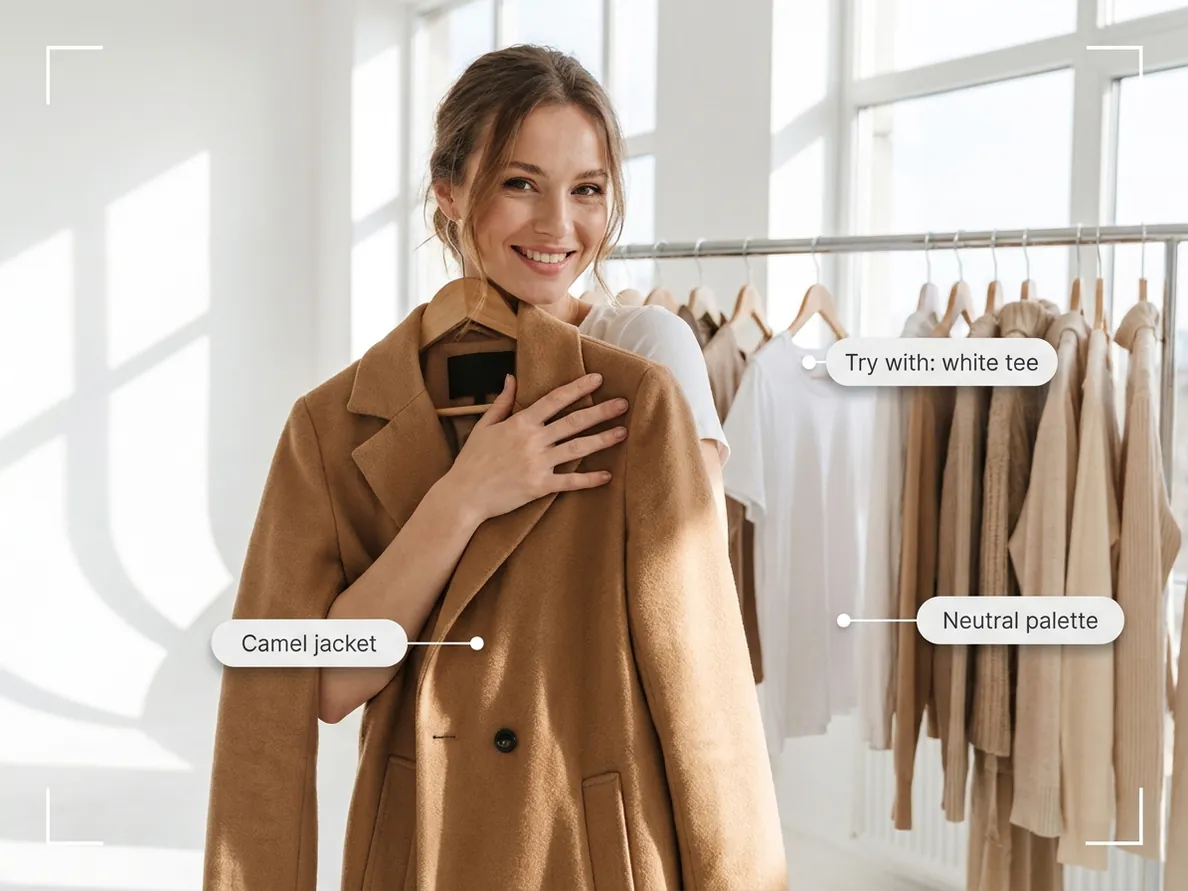
What the software does with a photo
Underneath the friendly chat window, most of these tools do the same few jobs. They recognize a garment from a picture, tag it with a category, color and pattern, store it in a digital closet and then combine tagged pieces into outfits. Some add weather, some add a shopping feed.
The recognition part rests on visual search. Google says Lens handles nearly 20 billion visual searches a month and connects results to a Shopping Graph of more than 45 billion products. That scale is why photo-based shopping has become normal. It does not mean every tool is that accurate on every item. Lens-style systems are better at broad categories and dominant colors than at obscure, vintage or badly photographed pieces.
What a model sees is a flat image. It can tell you a jacket is olive, cropped and has a structured collar. It cannot tell you the wool is scratchy, the lining is cheap or the sleeves are a half inch too short on you.
The tasks an AI stylist handles well
- Cataloging a closet. Photograph each piece once and the app keeps a searchable list. Acloset, for example, builds a virtual closet from photos.
- Fast combinations. It will pair a blazer with eight different bottoms in seconds, including pairings you would not try.
- Weather-aware picks. Some apps, including Acloset, factor in the forecast when they suggest what to put on.
- Finding items from screenshots. Some apps support shopping from text or screenshots.
- Getting you unstuck. A random suggestion is sometimes all you need to break a pattern of wearing the same three outfits.
For men and women alike, the best result comes from tasks with clear inputs. "Make five outfits from these twelve pieces" works. "Make me look more interesting" does not.
Where the software falls short
Software does not know the things a human stylist picks up in the first five minutes. It does not see how a fabric drapes in motion or how you stand and walk. It does not hear that you hate tucking shirts, that you carry a laptop bag or that your office is freezing. It also lacks taste in the way a person does. It assembles combinations that match, not combinations that surprise.
Virtual try-on, such as Google's try-on for shopping listings, is a good example. AI images can change fit, color or garment details, so they are not reliable evidence of how something will fit or what it is made of. Use try-on pictures for mood, never for buying a size.
Material is another limit. A model can guess leather from a surface, but a photo cannot verify fiber content. The product label or the maker's page is the place to check. The same applies to brand and authenticity. A logo resemblance proves nothing on its own.
What styling apps cost
Most apps are free to start and charge when you want more. Pricing below comes from one comparison dated November 2026, and prices change, so check the app's own pricing page for current numbers.
| App | What the comparison lists |
|---|---|
| Acloset | Free tier up to 100 items. Basic $3.99 per month, Premium $9.99 per month |
| Fits | Pro plans at $9.99, $29.99 and $59.99. AI credits start at $1.99 for five |
| Style DNA | Subscriptions from $7.99 per month |
| Pureple | Weekly plan at $6.99, Pro plan at $14.99 |
| TryAnyOutfit | Setup is free, but renders are not |
Free tiers are fine for a trial month. Add 20 or 30 of your most-worn pieces first, since an outfit list built from a half-empty closet will feel repetitive and you will blame the app.
The pattern is worth noticing. The cheap tier usually covers cataloging. The AI chat and image generation sit behind credits or a higher plan. If you only want to stop forgetting what you own, you may never need the expensive tier.
Style DNA also builds a profile from a selfie. A color type from any such tool can be a useful starting point for your palette, but treat it as a suggestion, not a rule. Wear the colors that make you feel good.
App versus human stylist
A human stylist is not a luxury item only for events. A tailor, a shop assistant or a friend with a good eye can be a human stylist for the cost of a coffee. The split is simple.
| Question | AI stylist | Human stylist |
|---|---|---|
| Speed | Seconds, any hour | Appointment or favor |
| Knows your closet | Yes, if you photographed it | Learns by seeing it |
| Feels fabric and fit | No | Yes |
| Understands context | Only what you type | Reads the room |
| Cost | Often free to a few dollars a month | Varies by service |
| Surprise and taste | Limited | Often strong |
The sensible use is to combine them. Let the app do the sorting and the first drafts, then ask a person about the final call on anything important. If a piece you saw is too obscure for software, a human fashion community can help. The r/findfashion forum is named in one 2026 guide as a fallback for difficult items, though replies are not guaranteed.
How to get better results from an AI stylist
- Photograph each item on a plain background in even light, whole garment visible.
- Add the details yourself. If the app guessed "navy" and it is black, fix it.
- Give context. Say where you are going, how long you will be out and what you cannot stand wearing.
- Ask for a few options and a reason for each, then check the reason against your own eye.
- Verify any item on the retailer's own page: price, stock, size and returns.
If you want to compare a suggestion with something real, run the item through search and look at several results, not only the first. A match in color and shape does not prove it is the same product. Check logo placement, hardware, seams and dimensions against the listing.
And pay attention to the advice itself. It may ignore weather, comfort, dress code or your preferences. If a suggestion would be miserable to walk in, do not wear it because a screen said so. For a plain, practical approach to dressing for a day, see what to wear today.
Using photos of a look you already like
One of the most useful things these tools can do is start from a photo of someone whose outfit you admire. Upload it to the scanner above and you get a description of the pieces. From there you can chase the individual items, for example by shopping the look piece by piece or by using a dupe finder when the original is out of budget.
When you want feedback on a finished outfit you are wearing, use an outfit checker. When you want a start-from-scratch combination for one item, an outfit generator does that. Different tools answer different questions, and an app that claims to do everything usually does a few of them averagely.
Privacy in AI styling apps
Wardrobe apps may process clothing photos, selfies, body images, screenshots and purchase information. How long they keep data, whether they train on it and who they share it with differs by app. Read the current privacy policy before uploading selfies, and do not upload someone else's photo without permission. If a child is in a photo, get a guardian's consent or leave the image out.
When a photo you found online led you to an item, also remember that the picture may be copyrighted. Identifying a jacket does not give you permission to reuse the image.
To begin with something simpler than a full wardrobe app, you can start from a single picture and learn what is in it by finding outfits from a photo.
Still wondering about AI styling?
What is the best app for styling clothes?
It depends on what you need. Acloset suits cataloging a closet from photos, with a free tier up to 100 items. Fits adds swiping and AI chat with paid credits. Pureple generates outfits and scores looks. Try the free tier of two, and keep the one that you actually open on a rushed morning.
How to be a virtual stylist?
Start with a few friends or an online community and offer to build outfits from their existing clothes and photos. Learn about silhouettes, color pairing and fit, and always ask about budget, climate and daily routine. Keep a portfolio of before and after photos with permission. Tools help with cataloging, but your eye is the service.
How are fashion designers using AI?
Designers and retailers use it for trend spotting, product tagging, visual search and showing customers similar items. Shoppers see the results as photo search and recommendations. Specific company practices vary and many are not published in detail, so look at a brand's own announcements if you want to know what it actually uses.
Can an AI stylist replace a personal stylist?
Not completely. An app is quick, cheap and good with a catalog of your own clothes. A person can feel fabric, see how a piece moves on you and understand your job, climate and taste. Many people use the app for sorting and first drafts and a person for big decisions.
Are AI stylist apps free?
Many offer a free starting tier with limits. One November 2026 comparison lists Acloset's free tier at up to 100 items, with paid plans of $3.99 and $9.99 a month. Features such as AI chat, credits and image generation often cost extra. Prices change, so check the app's pricing page before subscribing.
Is it safe to upload my clothes and selfies?
It depends on the app. Look in its privacy policy for retention, training use, deletion rights and sharing with third parties. Upload clothes on a plain background rather than full photos of your home. Skip selfies if you are not sure, and never upload another person's photo without permission.
Can an AI stylist tell me what a piece is made of?
No. A photo shows surface and color, not fiber content. A model can guess leather or silk from appearance, but a guess is not a fact. The label, the product page or the manufacturer's specification gives the real answer, and the same goes for brand and authenticity.