Decide what similar means for this dress
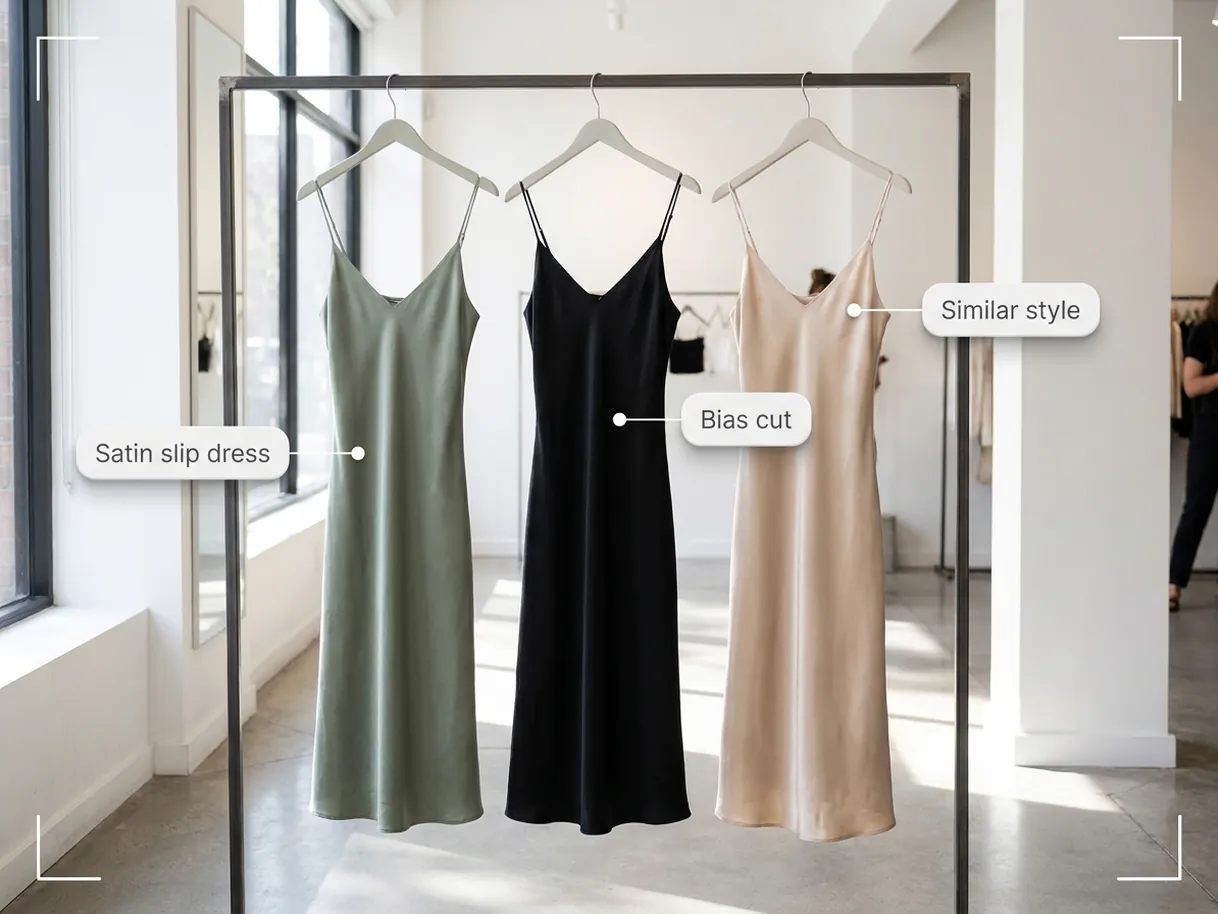
Similar is a sliding scale, so set your limits before you search. Dress-finding guides suggest comparing neckline, sleeves, fabric, fit, length, pattern, color and price when you judge a match. That is a long list, and no lookalike will win on every line. Rank the features that made you stop at the photo.
Here is how we would rank them. Silhouette and neckline carry the look from across a room, so they come first. Length comes next, because it changes how the dress behaves when you walk and sit. Fabric is what you feel and what drives the price, so it is where most shoppers should be willing to bend a little. Trim, buttons and hardware are the easiest things to give up, and sometimes the easiest to swap later. Color and print matter most when the dress is a solid statement shade or a bold pattern.
When the cut has no name you can recall, feed the picture to the scanner above. It returns a brief description with a confidence level, and those words go straight into your search. If the piece is really a blouse rather than a dress, tracing the top from a photo works the same way.
How to describe a dress like this in search terms
A good query reads like a product title. Put the shape words in the order a store would, usually length, silhouette, neckline, sleeve, fabric and then color or print. Compare these two searches. "Pretty green dress" matches thousands of items. "Midi wrap dress, V-neck, long sleeve, matte woven, forest green" matches a small group you can actually compare.
Fabric words are worth the effort, because they separate dresses with identical outlines.
- Satin sheen for a glossy, fluid surface.
- Velvet pile for a soft, light-catching nap.
- Lace for an open, patterned structure.
- Chiffon for a transparent, floaty layer.
- Knit texture for ribbed or sweater-like surfaces.
- Denim, sequins, leather or a plain matte woven cloth.
Add one distinctive detail if you can. Bows, cut-outs, a slit, pleats, gathers, ruffles and pockets all narrow a search faster than another color word. If the first query is too narrow and returns nothing, drop the detail before you drop the silhouette.
Length words need a second look, because stores define them differently. Maxi generally reaches the ankle or floor, while tea-length ends around mid-calf. If you are not sure, search both words, or use the retailer's own length filter.
Visual search tools for lookalike dresses
Words get you to the right neighborhood. Image search finds the specific street. Different tools suit different jobs.
| Tool | Best use for lookalikes | Limits |
|---|---|---|
| Google Lens | Broad web lookup, product pages and shopping results for visually similar dresses | Free; accuracy depends on the image and what is sold online |
| Pinterest Lens | Adjacent looks, outfit ideas and shoppable suggestions | Free; stronger for style than for proving an exact product |
| Lykdat | Fashion-focused search for similar retail clothing | Web-based; catalog coverage and prices change |
| Bing Visual Search | Visual shopping and image matches | Free option; catalog coverage varies |
| Yandex Images | Similar images and, sometimes, shopping results | Free option; results and availability differ by region |
| TinEye | Finding exact or reused copies of the image | Free option; not a fashion catalog |
One 2026 guide says Lykdat launched in 2018, so it has been around longer than most newer clothing scanners. TinEye plays a different role from the rest. It helps you find where the photo itself was published, which can lead to a caption, and it is less about classifying a dress style.
Fashion communities such as r/findfashion can also name hard pieces, vintage items and obscure labels. Treat a community answer as a tip and check it yourself.
A search order that saves time
Start with a tight crop of the dress, with faces and other clothing removed. Then work in this order.
- Run the crop through Google Lens and note any brand, product name or print name in the results.
- Run the same crop through Pinterest Lens and Lykdat to see a wider set of looks.
- If the results are weak, try TinEye, Yandex Images or Bing Visual Search.
- Search the text clues you collected, such as a style term or product name, in a normal search box.
- Open candidates on the retailer's own page and compare them with your photo.
Step four is the one most people skip. A lookalike's own product title is free vocabulary. If a store calls the dress a "ruched satin slip midi", copy those words into your next search. The store has already done the naming for you, and other retailers often use similar language for similar dresses.
If the exact dress is what you want and nothing so far has surfaced it, our guide to tracing the original dress from a photo covers source-tracing and listing checks that this page skips.
Use filters instead of scrolling
Once you have a few stores that stock the right sort of dress, stop scrolling and start filtering. Most fashion retailers let you filter by length, neckline, sleeve type, fabric and price. Set the three that matter most to you, then sort by newest or lowest price.
Search inside a store with the phrase you wrote earlier. A short, specific phrase beats a category page of five hundred dresses. Save two or three candidates from each store, not twenty. A shortlist you can compare side by side beats an open tab for every dress that looked roughly right.
If you are shopping for the whole look and not only the dress, the shop the look approach breaks an outfit into items you can search one by one.
Price tiers and what each one costs you
A lookalike is usually cheaper, and the difference tells you what to expect. A lookalike can cost a fraction of the original, so a statement dress and its lookalikes can sit far apart on price.
When a price falls, something changes. Usually it is one of these.
- Fabric. A satin surface can be polyester, nylon, acetate or silk, and only the label tells you which. Silk identifies a fiber, while satin names a weave or finish.
- Construction. Compare the seams, lining and closure in the listing photos.
- Detail. Matching hardware and print placement are harder to copy cheaply than a general shape.
A photo cannot verify fabric composition, so read the material line on the product page. For the tier you can afford, pick the feature to protect. If you want the drape of a certain fabric, accept a simpler neckline. If the neckline is the point, accept a plainer cloth.
When you want a structured way to weigh a copy against the original, comparing dupes with originals lays out the checks. A retail duplicate is not automatically a counterfeit, but matching product photos do not prove that a seller is authorized or that the item is genuine.
Sold out, discontinued or only available used
A sold-out dress has not necessarily disappeared. It may be listed secondhand, restocked in another color or sold by a retailer in another region. It may also be gone for good. Do not assume an exact match exists for a discontinued item, and plan for a lookalike from the start.
If you have a brand or product clue, retailer or brand customer service can confirm the product name, season, fabric and stock. That only works when you can name a plausible brand, so do the identifying first. When you have the name, search it on resale marketplaces and set up saved searches if the platform offers them. Photos on secondhand listings are not proof of authenticity, so look for labels, measurements and the seller's return policy.
If the name is the missing piece, dress style names and label clues help you describe the dress precisely enough to find it.
Compare candidates side by side
Put your original crop next to each candidate and work down the same checklist every time. Silhouette, neckline, sleeves, length, fabric appearance, print placement, seam lines, hardware and any label. Identical print placement, seam arrangement, hardware and product photography are stronger evidence than color or overall shape.
Look at the back, the side view, the hem and the closure. The front is what a seller wants you to see. The back often shows whether the dress has a lining, a zipper or a different cut. If the listing hides all of that, ask for more photos or move on.
Read the listing closely when you pick a lookalike
Open the retailer's product page, not just the image preview. Then check the material, the size chart, the actual garment measurements, the stock date, the seller's identity, the shipping cost, the return policy and the total price with taxes. A listed size is a label, and garment measurements are the real test of whether it will fit.
Be careful with an unfamiliar seller reached through an image result. Verify their contact information, return address, reviews and payment protections, and do not enter payment details until they check out. A visual match also cannot verify fabric composition, fire safety, sizing accuracy, chemical safety or ethical production. For those, you rely on the label, the seller's documentation and the platform's protections.
Keeping your photo private while you search
Clothing photos often include faces, children, home interiors, location clues and metadata. Crop or remove them before uploading. Product photos can be copyrighted, so use them to identify an item for yourself and follow each platform's terms before you republish anything. Retention practices differ by service, so check the current privacy policy of any tool you use. Avoid using another person's identifiable photo without permission.
Where lookalike searches go wrong
- Uploading a full scene when only the dress should be in the frame.
- Searching a dark, blurry or heavily filtered screenshot.
- Trusting color, when camera white balance and indoor light shift it.
- Treating a similar silhouette as the same product.
- Buying before you count shipping, taxes and returns.
- Stopping after one visual search engine, when each returns different catalogs.
Fix those and a lookalike search gets quicker and calmer. For more ways to search from a photo across shoes, bags and shirts, start from the AI outfit finder homepage.
Which similar dress should you pick?
How do I find a dress like the one in my photo?
Crop the dress tightly, then run it through Google Lens and Pinterest Lens. Write the cut as a phrase with length, silhouette, neckline, sleeve, fabric and color, and search that in a store. Open the retailer page for each candidate and compare it with your photo. Judge by neckline, sleeves, fabric, fit, length, pattern, color and price, not by color alone.
What words should I search to find a dress like this?
Use the words a store would put in a product title. Start with length, then silhouette, neckline and sleeve type, then fabric and color. A phrase such as midi wrap dress with a V-neck and long sleeves in matte woven fabric beats pretty green dress. Add one distinctive detail, like a bow, a slit or pleats, if the first search is too broad.
How can I find a cheaper dress that looks like an expensive one?
Search the cut and fabric look, not the designer name, and filter retailers by price. One article on finding clothes by picture reported a $5,000 gown with similar alternatives at $120 and $80, though those are examples, not typical prices. Expect trade-offs in fabric, seams and hardware, and read the material line and measurements before buying.
Is Pinterest Lens or Google Lens better for similar dresses?
They do different jobs. Google Lens is stronger for web lookup, product pages and shopping results. Pinterest Lens is better for adjacent looks, outfit ideas and shoppable suggestions, and it is weaker at proving an exact product. Both are free according to the reviewed comparison. Run both on the same tight crop, then add Lykdat or Bing Visual Search if results are thin.
Can I find a similar dress if the original is sold out?
Yes, but do not assume the exact dress is still available somewhere. Describe the cut and fabric in a search, use visual search tools for lookalikes, and check resale listings. If you know the brand, customer service can confirm the product name, season, fabric and stock. Compare measurements and material on any candidate before paying.
Is a satin dress made of silk?
Not necessarily. Satin describes a weave or finish, and it can be made from polyester, nylon, acetate or silk. Silk names the fiber itself. A photograph cannot verify which one it is, so check the fabric composition on the product page or label. This matters when you compare a pricey original with a cheaper lookalike.
Which details matter most when a lookalike dress arrives?
Open the retailer's own page and check the listed material, size chart, actual garment measurements and stock date. Look at the back, hem, closure and lining photos. Confirm the seller's identity, shipping cost, return policy and the total price including taxes. A matching photo does not prove a seller is authorized or that the item is genuine.