
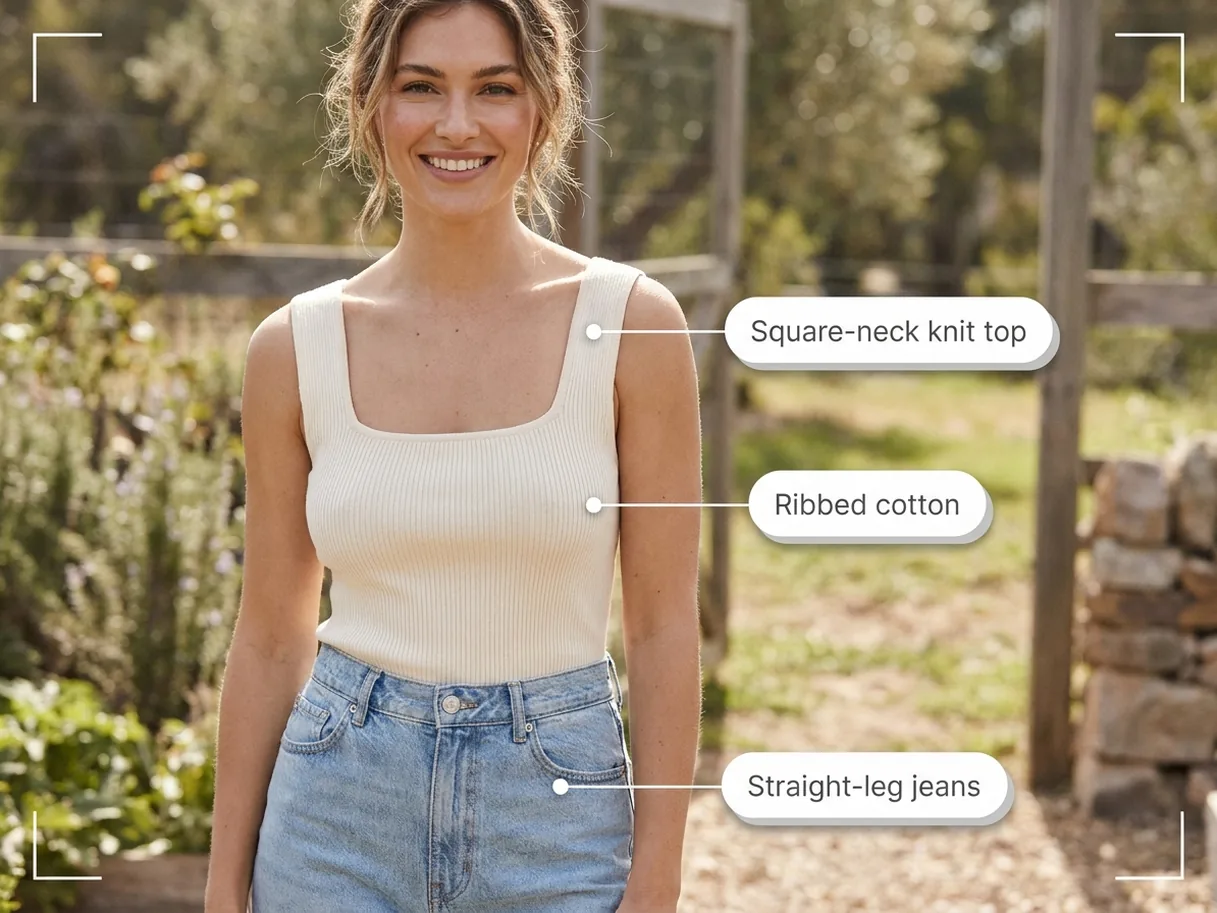
Name the kind of top before you search
"Top" is a big bucket. A ribbed square-neck knit, a satin cami, a structured corset, a cropped tee and a blouse with a tie neck all end up in different corners of a store, and search engines treat them differently. If you can say which one you are looking at, your results sharpen at once.
Look at the neckline, the sleeve length, the hem length, the closure and the fabric. A boned bodice with lacing or hooks and a fitted waist reads as a corset. Thin straps and a slip-like drape read as a cami. A short hem that stops above the waistband is a crop. Ribbing tells you it is a knit. Write down those four or five words before you open a single tool.
For a men's or unisex tee or button-up, the page about how to find a shirt from a photo fits better.
Isolate the top and keep the front view
Search one item at a time. The most common mistake is feeding a whole outfit to a search tool and hoping it picks the top. Crop the top away from the face, the background and the other clothing.
A front-facing image beats a side view, because side angles can hide the cut, the closure, the neckline and the length. If your only photo is a profile, say so in your notes and expect weaker results. Then make extra crops of anything distinctive. A label, a logo, a row of buttons, a ruched seam, a chain strap, embroidery or an appliqué patch all make good search crops on their own.
Skip low-resolution, mirrored, heavily filtered or compressed copies if a cleaner original exists. A mirror selfie reverses the print and the closure, and a filter changes the color.
Search tools worth trying for a woman's top
Start with Google Lens. It searches a camera image, an uploaded photo or a screenshot, and it can identify products, read text and logos, find similar items and show purchase or price information where available. In October 2024 Google put its monthly count of visual searches at close to 20 billion. Lens is listed as available through Android, iOS, the web and Chrome. It also lets you add words to refine patterns, colors and sizes.
Pinterest visual search works on a full image or on selected parts of one, and it can return similar or shoppable results where available. It is a good second pass for aesthetics, such as a particular knit or a vintage-style print.
Shop-specific tools can help when the top is probably from a major retailer. Find Wear says it searches visually across 28 countries and returns similar products, prices and store links. Coverage and features vary by country, so confirm that a tool works where you live before investing time in it.
No single tool wins every time. Run the top through two or three and look for the product that keeps showing up. Our shop-the-look page for outfit photos explains how to break a full outfit into items you can search separately.
Add words to the search
Lens lets you type extra terms beside the image. Use the vocabulary from your first step. Color, garment type, neckline, sleeve length, material, pattern, logo and any odd detail all help. Try "black ribbed square-neck long-sleeve knit top" or "ivory satin corset top with lace-up back." A tool that sees an ivory top and returns forty white ones needs the word "satin" or "lace-up" to tell them apart.
Do the same with color. Lighting and filters shift shades, so check the image under neutral light and look at the retailer's official color names, such as ecru, ivory or bone, before you decide the shade is wrong. A filtered photo may leave the exact shade unanswerable.
Use where the photo came from
A top in a screenshot often has more context than you think. A retailer watermark, an influencer handle, the title of a TV program, an event name or a date all narrow things down. Those details can tell you when the top appeared, which matters because a top from a past season has probably left the shelves.
One caution. A model's styling piece and the item you are hunting for are not always the same thing. A tagged post may point to the skirt, the bag or the shoes while the top is a stylist's own piece. Before sinking an evening into a brand, check whether anyone in the comments or the caption actually names the top.
When the top is part of a set, or a dress in disguise
Some tops are half of a matching set. A coordinated top and skirt can pass for a one-piece dress, and the other way around. Check the waist seam, the lining, whether the pattern continues from one piece to the next and what the closures do. If the pieces are sold together, searching for the top alone will keep missing, and you will do better searching the set. A photo that seems to show a dress belongs with the steps for how to find a dress from a photo.
Material questions a photo cannot settle
Leather and synthetic look alike on camera. Grain consistency, edge finishing, backing and the product specification tell them apart, and a photo alone cannot reliably settle it. The same goes for satin, ribbing, quilting and wool. Their sheen, texture and thickness are visible, so use them as search words, but treat the exact fabric as a claim until a product page or care label confirms it. A vintage original and a modern reproduction can look similar too. Compare the care-label format, country of manufacture, fabric composition, fastening design and any documented release date.
Is it the exact top or a lookalike?
A color and silhouette match is the start of the checking, not the end. Compare logo placement, pocket shape, hardware, stitching, print alignment and measurements. Treat a match as real only when at least two independent identifying details agree, for example a label and a stitching pattern, or a style code and a hardware detail.
Designer lookalikes and dupes are a separate matter. Matching how something looks tells you nothing certain about who made it, whether it is genuine, or whether the seller is allowed to sell it. If your real goal is a similar look for less, our dupe finder for designer looks is the better route, and you can say so in your search words with something like "similar to" in place of a brand name.
For expensive or disputed items, ask the seller for the label, the receipt, provenance and more close-up photos. A qualified authenticator is worth considering. Brand customer service and authorized retailers can also confirm a style code.
Comparing listings, resale and price
Once you have a candidate, build a small record. Write down the brand, style name or code, seller, country, size chart, composition, listed price, currency and the date you looked. Prices, stock, links and app features change over time and by market, so the date matters.
For discontinued tops, resale marketplaces such as eBay can help you compare active and sold listings. An asking price is not what the top sold for, so check completed sales. A retail price and a resale price are separate facts. Then check the final price, stock, size, shipping, taxes and return policy for your country.
Walk away from counterfeit sellers, off-platform payment requests, impossible discounts and any request for identity documents.
Mistakes that keep you from finding the top
- Searching the whole outfit when you need one item.
- Matching on color or general shape only.
- Taking the first visual result as the match.
- Ignoring regional spelling, currency, size systems and discontinued products.
- Relying on one marketplace listing or an unsold asking price.
- Assuming an AI description proves fabric, authenticity, date or brand.
- Forgetting to record the date you searched.
To get a written description of the top that you can turn into search words, try the scanner above. For a wider view of finding outfits from a photo, start from the AI outfit finder home page.
What to crop out of a photo, and what to check
Photos carry more than clothes. They can show faces, children, addresses, location data, screenshots and account names, so crop or blur anything unrelated. Read each service's privacy policy, retention terms and training practices before you submit an identifiable image. Uploading a picture does not hand you the right to reuse it. And do not use someone's photo to identify, track or expose them.
Is this top worth chasing?
How do I find where a top is from using just a photo?
Crop the top away from the rest of the outfit and run it through Google Lens, then try Pinterest visual search. Add words for the neckline, sleeve length and material. Compare the products that repeat against the label, hardware and stitching. Treat the result as unconfirmed until two independent details match.
Can Google Lens find a top from a screenshot?
Yes. Google Lens accepts a screenshot, an uploaded image or a camera shot. It can identify products, read text and logos, and show similar items, with prices or purchase information where available. Crop the top first so Lens does not latch onto the skirt or the background.
How do I find a top that an influencer or TV character wore?
Check the screenshot for a retailer watermark, handle, program title or date, since these narrow down the season. Then search a crop of the top. Remember that a tagged post may point to a different item, and a stylist's own piece may never have been sold at retail.
What can I do if I only have a side view of the top?
A side view hides the cut, closure, neckline and length, so results are weaker. Crop any detail that shows, such as a seam, strap or hardware, and describe the top in words. Look for a second photo from the same event or account that shows the front.
Is a visual search result proof that I found the right top?
No. Tools return similar products, and a result can match in color and shape and still be a different item. Compare logo placement, pocket shape, hardware, stitching and print alignment. Count it as a match only when at least two independent details agree.
How do I find a sold-out or discontinued top?
Search resale marketplaces using the brand, style name or code from any old listing. Check sold listings for what it really went for, since an asking price is not a sale price. Archived pages and a care label can confirm the season. Look for a similar top at current retailers if nothing turns up.
Which search tools work for women's tops?
Google Lens and Pinterest visual search cover most photos. Amazon's visual search works mainly for items sold on Amazon, and ASOS Style Match is fashion-focused. Find Wear says it covers 28 countries. Availability and brand coverage differ by market, so test a tool on your photo before relying on it.